Simple Linear Regression
Week 13
Nov 12, 2025
Plan
- Motivation: correlation, causality, and prediction
- Model: \(Y = \alpha + \beta X + U\)
- Least-Squares Estimator (LSE)
- Geometric intuition of OLS
- Empirical example (cigarette data)
- Prediction vs causality
- Check Your Understanding & Exit Question
Textbook Reference: JA Chapter 17
Motivation
- Correlation tells us how two variables move together.
- Regression quantifies how much \(Y\) changes when \(X\) changes.
- Two perspectives:
- Predictive: best line for forecasting \(Y\) from \(X\)
- Causal: effect of changing \(X\) on \(Y\)
The Model
\[
Y_i = \alpha + \beta X_i + U_i
\]
where
- \(Y_i\): dependent (response) variable
- \(X_i\): independent (explanatory) variable
- \(\alpha\): intercept
- \(\beta\): slope (effect of \(X\) on \(Y\))
- \(U_i\): unobserved factors
Assumption: \(E[U_i|X_i] = 0\) ensures unbiased estimation.
Least Squares Estimator (LSE)
Goal: minimize the Sum of Squared Residuals
\[
S(\alpha,\beta)=\sum_i (Y_i - \alpha - \beta X_i)^2
\]
First-order conditions:
\[
\frac{\partial S}{\partial \alpha}=0,\quad
\frac{\partial S}{\partial \beta}=0
\]
Solution:
\[
\hat{\beta}=\frac{\sum_i (X_i-\bar{X})(Y_i-\bar{Y})}{\sum_i (X_i-\bar{X})^2},\qquad
\hat{\alpha}=\bar{Y}-\hat{\beta}\bar{X}.
\]
R Example: Computing LSE Manually
data(cigdata)

x <- cigdata$cigtax
y <- cigdata$cigsales

beta_hat  <- cov(x, y) / var(x)
alpha_hat <- mean(y) - beta_hat * mean(x)
c(alpha_hat, beta_hat)
Using lm() in R
model <- lm(cigsales ~ cigtax, data = cigdata)
summary(model)
Call:
lm(formula = cigsales ~ cigtax, data = cigdata)

Residuals:
    Min      1Q  Median      3Q     Max
-23.921  -8.098  -0.857   5.014  39.338

Coefficients:
            Estimate Std. Error t value Pr(>|t|)
(Intercept)   55.949      3.244  17.249  < 2e-16 ***
cigtax        -9.487      1.511  -6.277 8.75e-08 ***
---
Signif. codes:  0 '***' 0.001 '**' 0.01 '*' 0.05 '.' 0.1 ' ' 1

Residual standard error: 12.52 on 49 degrees of freedom
Multiple R-squared:  0.4457,    Adjusted R-squared:  0.4344
F-statistic:  39.4 on 1 and 49 DF,  p-value: 8.754e-08
Interpretation:
- Intercept (\(\hat{\alpha}\)) – predicted sales if tax = 0
- Slope (\(\hat{\beta}\)) – change in sales per $1 increase in tax
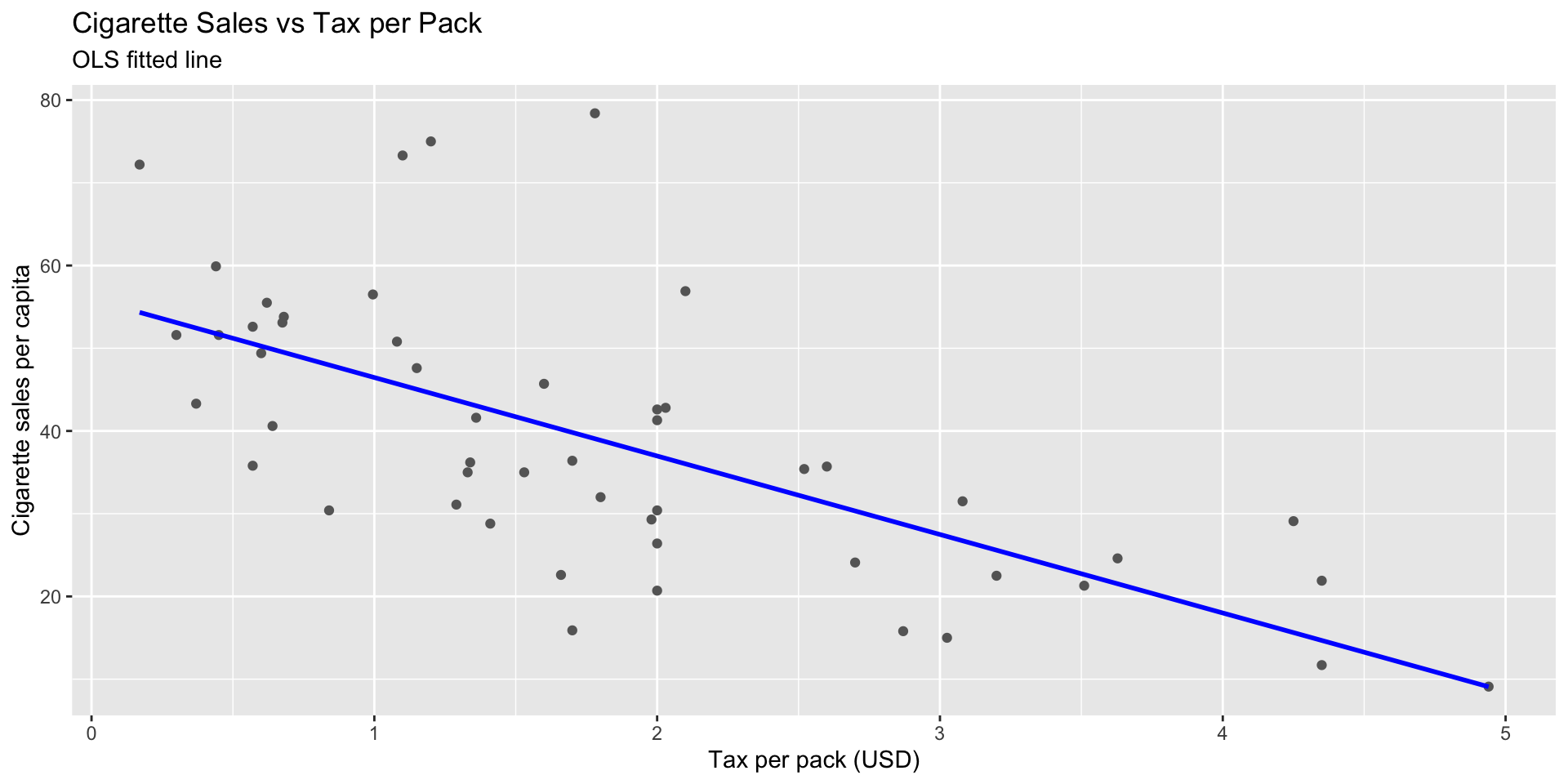
Visualizing the Regression Line
ggplot(cigdata, aes(x=cigtax, y=cigsales)) +
  geom_point(color="grey40") +
  geom_smooth(method="lm", se=FALSE, color="blue") +
  labs(title="Cigarette Sales vs Tax per Pack",
       subtitle="OLS fitted line",
       x="Tax per pack (USD)", y="Cigarette sales per capita")
![]()
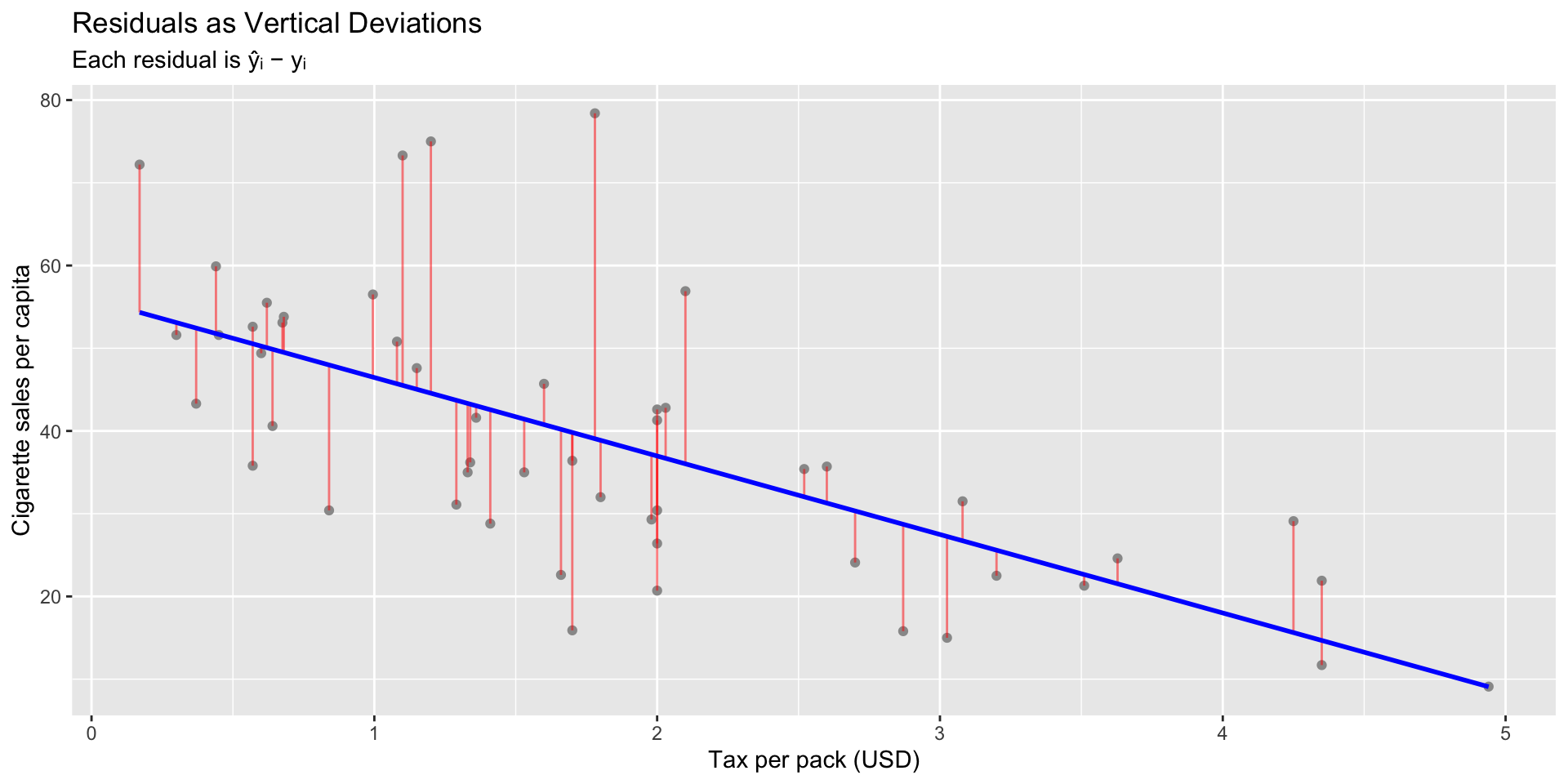
Residuals and Fit Illustration
cigdata <- cigdata |>
  mutate(fitted = fitted(model),
         resid  = resid(model))

ggplot(cigdata, aes(x=cigtax, y=cigsales)) +
  geom_point(color="grey60") +
  geom_segment(aes(xend=cigtax, yend=fitted), color="red", alpha=0.5) +
  geom_smooth(method="lm", se=FALSE, color="blue") +
  labs(title="Residuals as Vertical Deviations",
       subtitle="Each residual is ŷᵢ − yᵢ",
       x="Tax per pack (USD)", y="Cigarette sales per capita")
![]()
Geometry of OLS
- The regression line minimizes the distance (in squared sense) from all points to the line.
- Residuals are orthogonal to fitted values:
\[
\sum_i \hat{u}_i = 0,\quad
\sum_i X_i \hat{u}_i = 0.
\]
Economic Interpretation
- \(\beta\) measures marginal effect: how much \(Y\) changes for one-unit change in \(X\).
- Sign of \(\beta\) follows sign of correlation \(r_{XY}\).
- \(\alpha\) gives baseline level when \(X=0\).
- Units matter for interpretation.
Prediction vs Causality
| Goal: minimize prediction error |
Goal: estimate causal effect |
| Focus on fit \(E[Y|X]\) |
Requires \(E[U|X]=0\) |
| Works with any \(X\)–\(Y\) relation |
Needs exogenous variation |
| “What \(Y\) do I expect if \(X = x\)?” |
“What happens to Y if I change X?” |
Inference for the Slope Parameter
When assumptions hold:
\[
t = \frac{\hat{\beta} - \beta_0}{se(\hat{\beta})}
\quad \sim \; t_{n-2}.
\]
Use summary(model) in R to see \(t\) statistic and p-value.
Check Your Understanding
- Using the regression of
cigsales on cigtax, interpret the slope’s sign and magnitude.
- If the tax increased by $0.50, what is the predicted change in sales?
- Does this relationship necessarily mean higher taxes cause lower sales? Why or why not?
Exit Question
Under what condition can the regression coefficient \(\beta\) be interpreted as a causal effect?
Only if the exogeneity condition \(E[U|X]=0\) holds — that is, when changes in \(X\) are not systematically related to the unobserved factors \(U\).